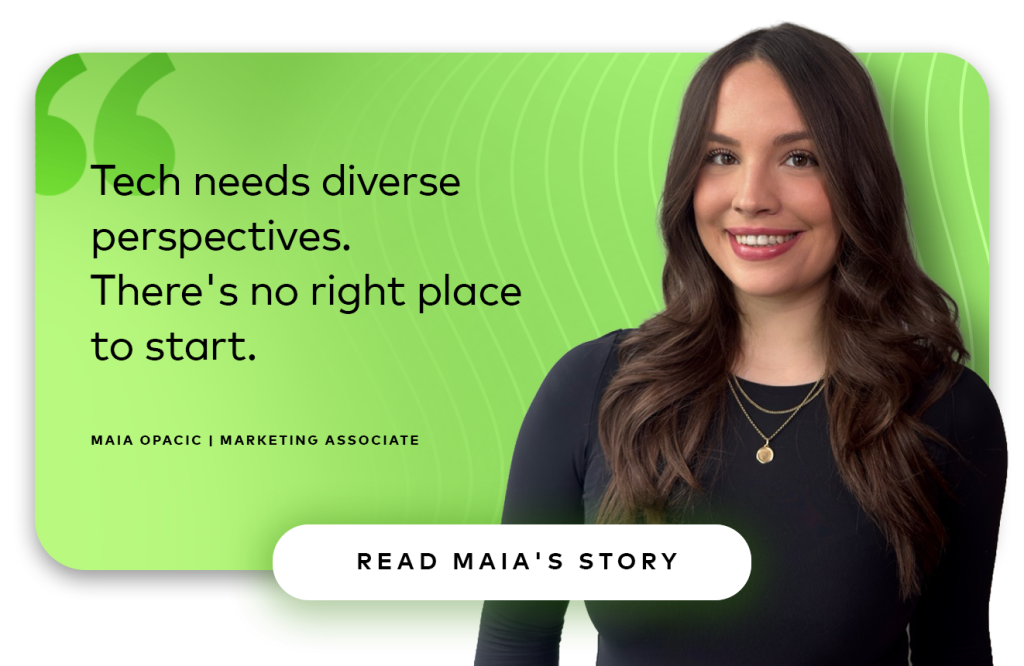
Maia Opacic started at Yardi as a marketing intern, where she focused on learning the processes, understanding the real estate industry and seeing how Yardi supports it. Today, she leads industry event support across trade shows, conferences and day-to-day marketing opportunities, and she’ll soon be stepping into a marketing associate role as she makes the transition from intern to full-time team member. She is also wrapping up her final semester in Toronto Metropolitan University (TMU) Real Estate Management programme this spring, continuing to build confidence through hands-on experience in the industry.
We sat down with Maia to talk about what she’s learning in real estate tech, what’s helped her build confidence and why she’s become more comfortable with the idea that you don’t need everything figured out to move forward. Her experience reflects a growing trend in tech: confidence built through exposure, not perfection.
To start off, tell us about your journey from intern to marketing associate and what you’ve been up to?
I started off as an intern trying to understand the processes, the industry and where Yardi fits into it all. Early on, a lot of my focus was learning how the team works day to day and getting comfortable with the tools, timelines and priorities.
Over time, I’ve felt more integrated and more confident speaking up. Now, when I spot something that could run smoother, I’m able to flag it and suggest improvements. That shift has been a big part of feeling like a real contributor, not just someone learning in the background.
My day to day now includes event coordination, working with external companies on events and day-to-day operations. What’s stood out most is how integrated I’ve felt. I’ve been included in meetings and projects in a way that makes me feel like part of the team.
Coming here made me really happy, and it confirmed that trying something new was the right decision.
You’ve had your hands in a lot. What’s been the biggest challenge so far, and how has it helped you grow?
Being challenged before feeling ready has been the biggest confidence builder for me.
Those are the experiences I’ve loved the most, the ones where I’m kind of thrown into something new. I’m okay being the intern who gets pulled into random tasks and projects because it’s all experience. It helps me figure out what I’m great at, what I’m not great at and what I actually enjoy doing. Even if I’m good at something, I’ve learned that doesn’t automatically mean it’s what I want to keep doing.
It also pushes me to learn fast and trust myself more. Once you get through a few of those moments, you realise you can handle more than you think.
Has school influenced your work, or has work influenced school?
I kind of want to switch it around. I think my role here has influenced how I approached school when I went back.
The work ethic I’ve developed on the job, and being exposed to the industry itself, has helped me do better in school.
I’m able to connect different topics we’re talking about now to real-world issues and case studies. I’m able to connect it to what I’ve learned in my internships.
A lot of what I’ve been exposed to is stuff I’ve already been taught in school, but it hasn’t stuck with me until I’ve been in the industry and started working on it.
What’s your approach to building relationships and finding mentors?
My approach is to treat them like a regular person at first.
If it’s in a workspace, I start with a small hi every couple of times and build into future conversations. That helps me get familiarised with people and make real connections. Those small interactions build trust over time, which is essential in any professional setting.
Leaders want to hire people they can connect with and work with. Even in downturns or hard times, they’re able to communicate with that person and get along with them.
What should today’s leaders keep in mind when they’re hiring and developing emerging talent in tech?
It helps to remember that not everyone comes in with a straight line on their résumé. I didn’t. I started at University of Toronto for business, realised it wasn’t for me, explored different options and ended up at TMU in real estate management. That path is part of what shaped how I work now.
Tech also benefits from diverse perspectives, and that includes people who don’t have a strictly technical background. I had no experience in tech and I’m here now.
Leaders who create space for early-career people to learn on the job, ask questions and get exposure to real work help them build confidence faster. Co-op and internships are a huge part of that, because they give students a real head start and help them figure things out along the way.
What matters most is finding people who are curious, coachable and willing to take ownership. The strongest emerging talent learns fast, flags issues early and brings solutions.
Looking ahead, what do you hope to see more of in the industry?
I think we’ve already built somewhat of a strong momentum with women in the industry. I’m hoping that momentum carries on and that we’re able to have a lot more women leaders in tech specifically.
For myself, I’d love to grow along that process, continue to take on new challenges and hopefully, in 10 years, be in a position where I can support or mentor other students.
One line that’s been sticking with you lately
I’ve been listening to an audiobook called Lean In, and something that stuck with me was: unconventional career paths create differentiation.
Want more conversations like this? Check out the rest of our Women in Tech series!