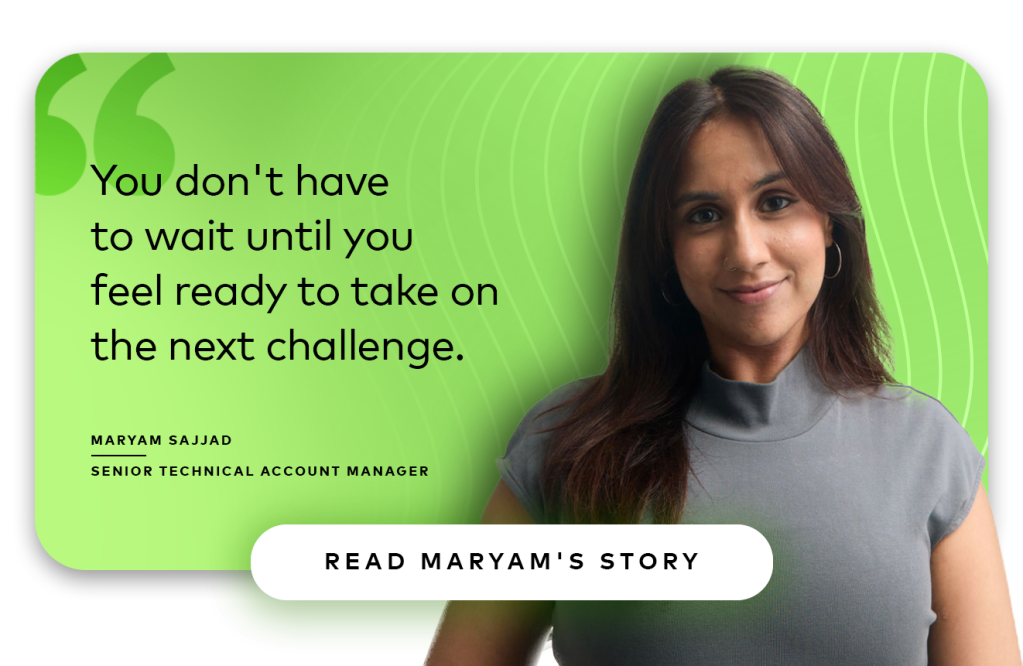
Maryam joined Yardi seven years ago and has grown from Associate Technical Account Manager to Senior Technical Account Manager. She started in client success before moving into implementation, where she now guides net new and full-service clients through data migration, product training and the operational changes that come with adopting new software. Her role sits at the intersection of clients, business needs and technology, and every day looks a little different depending on who she is helping and what they are trying to build.
We sat down with Maryam to talk about how she found her way into tech, what she has learned about turning complex client challenges into workable solutions and why she believes you don’t have to feel ready to take the next step. Her story reflects something we see again and again in this field: confidence comes from doing the work, not from waiting until the work feels comfortable.
You’ve grown from Associate to Senior Technical Account Manager. What has that journey looked like?
When I started, I was surrounded by people who came from accountingbackgrounds, and I was often one of the few women on the team. Michael Alleyne was my mentor early on, and he was gentle and patient in the way he explained concepts. That mattered. It taught me how much value there is in having people in dominating groups who vouch for you and advocate for you.
Later I moved to Jodi Ann’s team, and she was the one who pushed me toward implementation. She taught me something I still carry with me, which is that you don’t have to wait until you feel ready to take on the next challenge. You just take it, and the things you fail at are the things that force you to learn. Watching her step into a team lead role so early showed me what leadership can look like.
You’ve worked across client success and implementation. How are they different?
In client success, clients are calling or chatting into support, and every case is a different client with a different question. Implementation is a much closer relationship. You’re the first point of contact after sales. You’re training the client on how to use the program, guiding them through migration and coordinating across teams like sales, payment processing and support.
It was something I started to excel at, and I think that is because so much of it comes down to relationships. During a kickoff call I get to know the client, their team and the different roles involved. Then I relate their situation to similar clients I’ve worked with so I can show them the different options and pathways available. My confidence in that moment helps build their confidence too, and they know they can always come back to us for more training or if they run into an issue.
What first sparked your interest in technology?
Honestly, I moved to Toronto on a whim and was applying to anything. I had done a lot of internships and a lot of interviews, and eventually I interviewed with Ian Robinson and Corey Hawkes at Yardi. What kept me here was the people. Everyone has been at Yardi for so long, which is not common at other companies. There is something wholesome about growing alongside the same team, both personally and professionally.
Your current role turns complex client challenges into technical solutions. What’s one skill that changed how you approach problem-solving?
Excel. It sounds simple, but getting good at Excel, or really any platform that helps you clean data, has been invaluable. Cleaner data helps us implement a client’s information into the software faster because we’re not spending time correcting problems after the fact. It also matters because multiple teams work on the software together, so you want the handoff from one team to the next to be as seamless as possible. If the leasing team or front desk doesn’t have the right numbers, the accounting gets thrown off, and it all trickles down from there.
Large implementations involve migration, configuration and operational change. What do clients underestimate?
A lot of clients come in very eager to go live right away, and they underestimate the training involved to get comfortable with the program. Because several teams will be using the software, all those people need to be adequately trained, not just one group.
What makes an implementation successful is communication from the very beginning. I need clients to share their operational needs early, including the nitty gritty details, because otherwise you get surprises in the third or fifth month when someone realizes what they wanted isn’t set up the way they expected. Clean data, proper team training, setting expectations early and consistent communication until they’ve graduated from us. That combination is what gets clients to a strong launch.
How have mentors and leaders influenced your growth?
Every team lead I’ve had has been great at recognizing my strengths. My current team lead, Ethan, has pushed me to perform beyond what I thought I was capable of. Any time an opportunity comes up, he puts my name forward and asks whether I’m interested, and that has made a real difference. Jodi Ann pushed me into implementation and into taking on conversion setup projects back when our team was handling Genesis to Breeze work. I’ve been fortunate to have leaders who saw what I could do before I fully saw it myself.
Now that you’re in a senior role, what do you enjoy most about mentoring newer team members?
I try not to give unsolicited advice, but when someone comes to me with a situation, I share anecdotes from things I’ve experienced so they have something to relate to.
The part I really love is learning from them. There’s a younger generation entering the workforce that grew up with technologies we weren’t used to, and it’s genuinely cool to see how they navigate the space and interact with clients. Their mindset is different too. When I interviewed, I was thinking about how to prove I was worthy of the spot. They’ve flipped that, and they walk in asking what the company can offer them. They’ve also taught me about work-life balance. Once it hits five o’clock, log off. Do your best while you’re on the clock and then let it be. I love that.
What advice would you give to women interested in tech?
Don’t let your educational background deter you from applying to a position in tech. Early in your career especially, say yes to as many opportunities as you can so you get a sense of what you enjoy and what you’re good at.
And remember you don’t have to feel ready to take the next step. Just take it, and you’ll learn more from treating it like a challenge than from waiting until you feel prepared. The one thing I’d add is to be intentional alongside that. I tend to attach myself to someone I’m inspired by, build a rapport with them, and then they become my go-to when I run into questions.
What excites you most about where SaaS and property tech are heading?
AI is a big one. Tools like Virtuoso have made it so much easier for Breeze clients to become experts in the program outside of our training calls. What makes me happy is seeing clients chat in between our weekly calls and follow up on the action items I’ve given them, because that tells me they’re really committing to the material we’ve covered.
Beyond the technology, I feel like there’s more space for women to grow in tech and property tech than there was when I started. Back then most of my team was men, and I was one of the few women on it. I’ve since seen a lot more women join the industry, and I hope that momentum keeps building. My advice to them is to take up space. You deserve to be there, and you deserve to learn from the people who inspire you.
Want more conversations like this? Check out the rest of our Women in Tech series!